2017/08/09 Commentary: North Korean Crisis? Or What?
© 2017 ROHR International, Inc. All International rights reserved.
Extended Trend Assessments reserved for Gold and Platinum Subscribers
Commentary: Wednesday, August 9, 2017
North Korean Crisis? Or What?
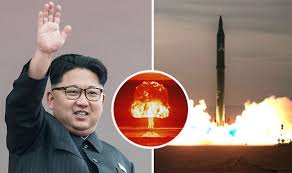 There is nothing like the image of your friendly neighborhood unstable dictator waving happily along with pictures of his newly confirmed intercontinental ballistic missiles (ICBMs) and a mushroom cloud to give the markets pause. And of course we say ‘neighborhood’ in the sense that media genius Marshall McLuhan noted back in the 1960’s that the new high speed video communications had turned the entire planet into a ‘global village’. And in addition to the awareness of what was going on in the whole rest of the world via communications, the extensive nuclear weapons and ICBMs built up by the major powers since the 1950’s meant that what was going on elsewhere in the world was also critical to everyone’s views, and even survival.
Yet even as bad as things were in the bipolar USA-Russia rolling confrontation during the Cold War out of the 1950’s until the 1991 fall of the Soviet Union, there was a sense of security from the geopolitical principle of ‘Mutually Assured Destruction’ (with the appropriate acronym MAD.) That was based on the war games theory that each side’s nuclear weapons arsenal was so massive as to assure the annihilation of both sides (and end of the civilized world) if either should ever launch a ‘first strike’ attack.
As such, it was reasonable to assume that both of the terrifyingly evenly matched sides had a vested interest in avoiding a nuclear war. Yet the confirmation that much smaller North Korean has achieved some real success with its long range missile program is more of an ‘asymmetric’ situation. That is even more the case as the US Defense Intelligence Agency has just reported it is likely that North Korea has also been able to miniaturize a nuclear warhead to fit on and ICBM; and that is two years ahead of previous estimates. Along with the ICBMs it is the key to being a real threat to the US.
Yet at least so far markets have taken this latest shock in stride, especially equities that might have otherwise been expected to react in horror to the prospect of anything with the potential to cripple the political and economic foundations of the West. Why?
Authorized Subscribers click ‘Read more…’ (below) to access balance of the discussion. Non-subscribers click the top menu Subscription Echelons & Fees tab to review options. The Market Observations remain the same as last weekend’s update (lower section) of last Wednesday’s Commentary: Summer? Must Be Kool-Aid Time! post, and there is no Extended Trend Assessment in this post.
NOTE: Given the likelihood the US economy will now get the structural reform that we (along with Mario Draghi and others) have been loudly complaining was not forthcoming since our dual It’s Lack of Reform, Stupid posts in January 2015, we need to adjust our view that a potential economic and equity market failure is coming. We previously referred you back to our December 8, 2015 post for our major Extended Perspective Commentary. That reviewed a broad array of factors to consider Will 2016 be 2007 Redux? While a continued regime of higher taxes and more regulation (i.e. under Clinton) might have fomented a continued weak or even weaker US economy, the tax and regulation changes proposed by the Trump administration will hopefully still be approved by the Republican Congress and diminish the similar fears we had to what transpired in 2007-2008.
▪ Well, in the first instance there is the scope of what North Korean (NOKO) dictator Kim Jong-un might do next. He is considered an ‘irrational’ actor for pursuing his nuclear weapons program in spite of embargoes and threats. Yet the ability and desire of North Korea’s allies (especially China and to a lesser degree Russia, Pakistan and Iran) to circumvent trade restrictions and look the other way on his armaments programs is well understood. It has been the case that all of the previous US administrations going back the Bill Clinton have tolerated this via phony negotiations and agreements.
That is because they did want to end up in a real confrontation with China over its erratic southern ally. There is so much analysis out there already on why China continues to support North Korea in spite of the problems it might cause that we will leave you to access that through other resources. In essence, China does not want a unified democratic Korea and relishes the problems North Korea creates for the West (which at this point also obviously includes the developed Asian economies.)
Strategic Patience
However, it is important to note that under the very lame international policies of the Obama administration regarding Russia, Europe and the Middle East there was also the principle developed regarding North Korea that they called ‘Strategic Patience’. It was very obvious to many international players that this was not just the Obama administration policy towards North Korea.
As of the moment that Barack Obama failed to act on his ‘red line’ on the Syrian government’s use of poison gas against its own people, all of the adversaries of the US understood that Obama was not going to take any action on anything. And so Russia, Iran and others that included NOKO felt free to operate as they wished in areas like Ukraine, Crimea, the Middle East and elsewhere.
And the term ‘Strategic Patience’ was especially damaging regarding any realistic chance to deter NOKO’s nuclear weapons ambitions. Instead of even any of the admittedly ineffective previous rounds of trade and other pressures, the North Koreans were free to pursue their nuclear arms ambitions unencumbered while the US showed absolutely no leadership that might have at least slowed it down. This was among the worst failures of the Obama administration, as admitted by the ex-President himself when he warned incoming President Trump that North Korea was his worst and most imminent problem.
Crazy Like a Fox
Yet within the scope of what drives the supposedly irrational activity of Kim Jung-un as he repeatedly challenges the West and especially the US is the key question: So is this guy truly crazy? Or just ‘crazy like a fox’?
Having now achieved two of the components necessary to present a real threat (ICBMs and miniaturized nuclear weapons) where does he go next. The answer is fourfold. The first step is to hone the reentry survival (given all of the heat generated in dropping back to earth) for his alleged miniaturized nuclear warheads. The second is to extend the range of North Korea’s ICBMs. And the next is to refine the triggering mechanism for the nuclear warheads, with the final step being accurate targeting for the entire enterprise.
The first two are fairly readily achieved with some study of the successful Western missile programs and future testing. The latter two are more challenging, yet with the triggering being more critical than the targeting. How much difference does it make if a NOKO nuke explodes over San Francisco instead of the targeted Los Angeles?
MAD Becomes IAD?
Yet all of this may still be silly in the context of the reality of likely outcomes from any NOKO nuclear attack on the US. And within his allegedly irrationality, Kim Jung-un likely fully understands this. What was MAD during the long term US-Russia Cold War confrontation is now likely IAD: ‘Individual Assured Destruction’.
The current NOKO threat is for an already ostensibly possible nuclear strike on the US Territory of Guam. That would be horrible, and the potential for a nuclear strike on Alaska and especially the continental US is an almost unimaginable horror. That would be on both a humanitarian and commercial level.
Imagine if that wayward nuke actually did hit San Francisco instead of Los Angeles. This could represent not only all of the obvious death and property destruction; it would also wipe out a major software and artificial intelligence center. The sheer electromagnetic pulse (EMP) would likely cause a major power and communications failure for the entire west coast of the US and possibly beyond.
However, there is no chance that Mr. Kim could knock out any meaningful percentage of the US nuclear arsenal. And in that regard he and his generals must surely know that any attack on the US (or even any of its allies through the Pacific Rim) would bring a massive retaliatory response from the US. In effect the exact result that North Korea and its primary benefactor China want to avoid at all costs.
After any singular or more broad based NOKO attack the North Korean state would cease to exist. As such, it seems that Mr. Kim’s bombast and accelerated development of the nuclear weapons program is more so for domestic consumption to solidify his position as undisputed leader than any real attempt to get into a nuclear war with the US. That he would now voluntarily give up his nuclear weapons is unfortunately also unlikely for that same domestic reason. The only example of this is Muammar Gadddafi in Libya, who was subsequently overthrown and killed by his people.
So IAD is likely the new way of the world when it comes to the NOKO nuclear arms program, and the acquiescence of the West to the idea of putting up with Kim Jong-un’s ravings about the belligerence of the West and suppression of his people. Sad but true, and not necessarily anything the markets are going to be concerned about for long unless Mr. Kim pursues obviously more belligerent behavior.
The question now is how long the weakness of the equities, residual bid in the govvies and interesting lack of any additional strong bid in the US dollar will last prior to the next ‘fig leaf’ of a US-China-NOKO diplomatic agreement (and possibly the re-opening of the previously useless ‘six party talks’.) The classically bombastic Trump statement on NOKO being hit with “…fire and fury like the world has ever seen…” is as usual neither realistic nor helpful, and Secretary of State Tillerson is already playing it down this morning.
More likely the West will grudgingly accept the existence of a nuclear North Korea, just as it has with regional powers like Pakistan. The alternative of a US military strike would be too disruptive for the relationship with China and way too costly for US allies in the region, especially the very vulnerable South Koreans who just elected a more pacifist new leader.
▪ There is no Extended Trend Assessment in this post. In spite of the short-term impact of various matters reviewed previous, the Market Observations remain the same as the update after last Friday’s Close (lower section) of last Wednesday’s Commentary: Summer? Must Be Kool-Aid Time! post.
Thanks for your interest.
The post 2017/08/09 Commentary: North Korean Crisis? Or What? appeared first on ROHR INTERNATIONAL'S BLOG ...EVOLVED CAPITAL MARKETS INSIGHTS.